Fortune 500 Web Accessibility Study 2026


We analyzed the Fortune 500 websites and unpacked where they currently stand on web accessibility. We set out to establish how many publish an accessibility statement, whether they meet WCAG 2.2 Level A and AA, and which criteria they fail most often. Of the 500, 389 returned a result. The remaining 111 could not be scanned, and are recorded throughout as not scanned.
The Fortune 500 is the annual ranking of the highest-earning companies in the United States. If any websites should meet WCAG standards, these should: they have the design systems, the QA teams, the budgets and the lawyers to get the job done. A barrier here is exclusion from an essential service by a company with every resource needed to prevent it.
A Brief Overview
This study reports on the 389 Fortune 500 homepages our scanner was able to reach and evaluate. The remaining 111 returned no result and are recorded throughout as not scanned – not as passes, and not as failures. Every figure below is of the 389.
Key Findings
Of the 389 Fortune 500 homepages we could scan, 352 (90.5%), failed at least one WCAG 2.2 Level A or AA success criterion.
- 90.5% fail WCAG. 352 of the 389 homepages we could scan break at least one Level A or AA success criterion.
- 69.2% publish an accessibility statement which changes nothing. 90.0% of companies with a statement fail anyway, against 91.7% of those without one.
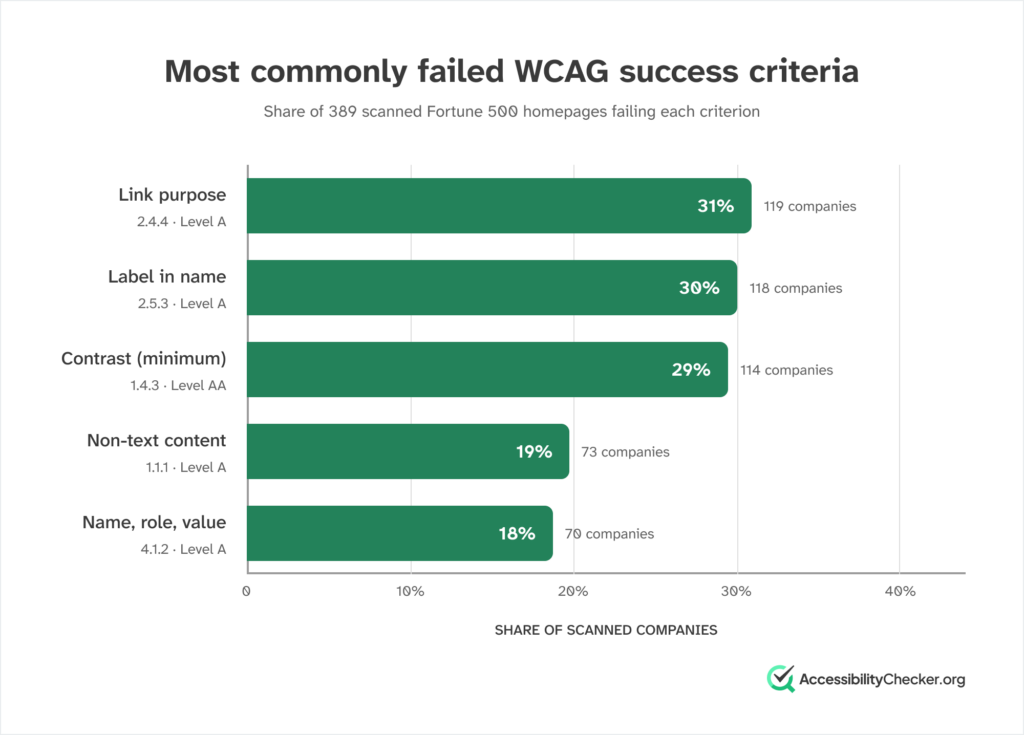
- 71% fail at least one of the five criteria that drive ADA website litigation such as alternative text, link text, button names, color contrast and label-in-name.
- The median score is 30 out of 100. No site scored above 90, and only 10 returned no detected failure of any kind.
- 11,597 individually failing elements across the sample, a median of 17 per homepage.
- 111 companies are recorded as not scanned. Their homepages could not be scanned, so they carry no score and appear in no figure in this study.
The Statement Gap
Just because a site has an accessibility statement doesn’t mean they’re compliant.
69.2% of the companies we scanned publish an accessibility statement. If a statement reflected what was happening in the codebase, the two groups should look different. They do not.
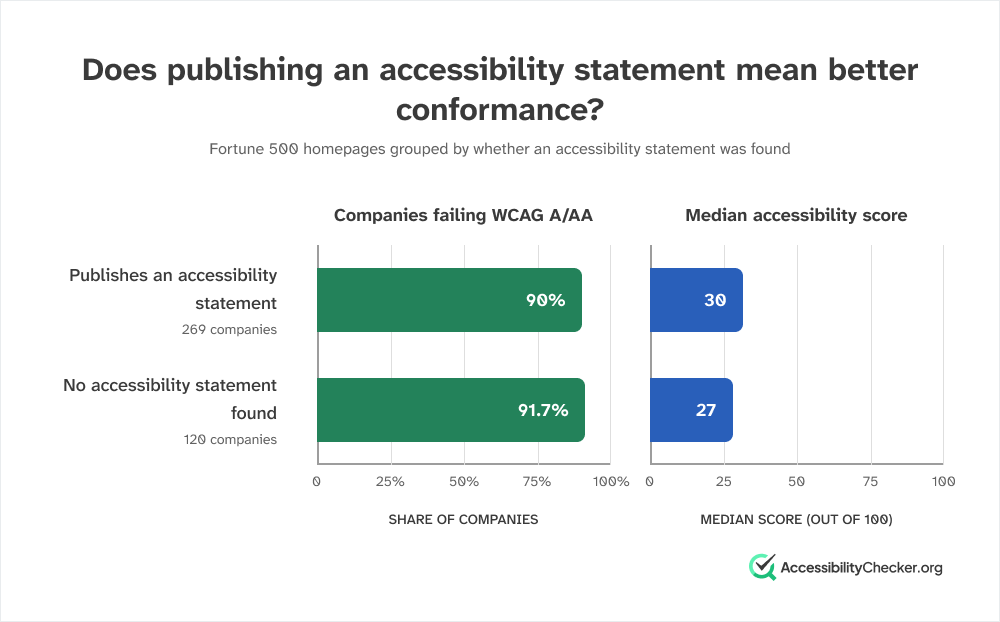
A 1.7-point difference on a sample this size is too small to mean anything. The median score gap, 30 against 27, is slightly better, but both sit deep in the failing range, and a three-point difference on a scale where the floor is 10 and nothing exceeds 90 is not a meaningful lead.
This is the part that should worry accessibility teams. Whatever the statement represents inside these organizations whether it’s a policy, a procurement requirement, a legal hedge, or a genuine commitment, it is not reaching the code of the page it is linked from. As a signal to a customer, a regulator or a procurement officer, its presence tells you nothing.
What the Statements Actually Say
We read 15 of the published statements in full. Eleven name a standard. None claims to have met it.
WCAG 2.2 Level AA is the most common target. Three name version 2.1 instead and three name WCAG without pinning down a version. Four also cite Section 508, one the European standard EN 301 549, and one the ADA itself.
| Company | Standard named | Score | A/AA fails | Conformance wording |
|---|---|---|---|---|
 |
WCAG 2.1 Level AA | 66 | 1 | “committed to making our website accessible” |
 |
None named | 10 | 6 | “committed to ensuring that our website and mobile applications are accessible” |
 |
None named | 24 | 3 | Long-standing commitment to accessibility; no standard cited |
 |
WCAG 2.2 Level A and AA | 84 | 0 | “strive to meet and exceed best practices and standards” |
 |
WCAG; Section 508; EN 301 549 | 42 | 2 | “prioritize inclusive design and accessibility in products and services” |
 |
WCAG 2.2 Level A and AA | 78 | 0 | “strive to provide a more accessible digital experience” |
 |
WCAG 2.2 Level AA | 10 | 5 | “have adopted WCAG 2.2 Level AA as our accessibility standard” |
 |
WCAG 2.2 Level A and AA | 42 | 3 | “adoption of and meaningful conformance with” WCAG 2.2 |
 |
WCAG 2.1 Level AA | 54 | 2 | “committed to conforming to WCAG 2.1, Level AA” |
 |
WCAG 2.2 A and AA; Section 508 | 10 | 3 | “Cisco adopts the Web Content Accessibility Guidelines 2.2, Level A and AA” |
 |
None named | 18 | 3 | “guided by international accessibility standards and relevant legal frameworks” |
 |
WCAG A and AA; Section 508 | 90 | 0 | “working to ensure that all Starbucks digital properties are accessible” |
 |
WCAG 2.2 Level AA | 60 | 0 | “ongoing accessibility effort works towards conforming” |
 |
WCAG; Section 508; ADA | 72 | 1 | efforts “are based on” WCAG, Section 508 and the ADA |
 |
WCAG 2.1 Level AA | 24 | 3 | “use the Web Content Accessibility Guidelines version 2.1 Level AA to guide our efforts” |
Not one of the fifteen claims to have achieved the standard it names. Every statement that names one qualifies it, and they nearly all do it the same way:
- “strives to meet”
- “works towards conforming”
- “is committed to conforming”
- “has adopted [the standard]”
- “meaningful conformance with”
Eleven of the fifteen fail at least one Level A or AA criterion on the very page their statement is linked from.
Legally, this wording is smart. A company that states it conforms, and does not, has put something in writing that a plaintiff can quote back at it. A company that states it strives has promised nothing a court can test.
So the statement ends up saying nothing useful. A document written to explain where a company stands has been drafted so carefully that it no longer says anything. You cannot tell from it whether the site works, and on this evidence you cannot guess either.
These 15 were selected to over-represent the largest companies in the sample. They show how these statements are written. They are not a representative sample of all 269.
The Scale
90.5% of the homepages we could scan fail at least one WCAG 2.2 Level A or AA success criterion. Count any detected failure, including best-practice checks, and the figure is 97.4%.
The median score is 30 out of 100. The mean is 34.4. Nothing in the sample scored above 90, and only 10 companies returned no detected failure at all. Across the 389 homepages, the scan found 11,597 individually failing elements. That is a median of 17 per page and a mean of 29.8.
These are not small or obscure sites. They are the corporate homepages of the largest companies in the United States, and the failures are spread across the whole list, not just the smaller companies.
The Not Scanned Group
111 of the 500 homepages returned no result. Their servers declined the automated request, most often with an HTTP 403. Bot protection of this kind is routine on large commercial sites and is not aimed at accessibility tooling in particular.
Rather than guess, we record these companies as not scanned: no score, no pass, and no fail. Nothing in this study should be read as a finding about their accessibility, because we hold no data on them.
It does mean the 389 are not a random draw from the 500. Large consumer brands are over-represented in the not scanned group, so the scanned sample leans a little toward corporate, industrial and financial sites. Worth remembering when you read the sector table.
How This Compares
WebAIM’s 2026 Million report tests the home pages of the top million websites with a different engine. It detected WCAG 2 failures on 95.9% of them, averaging 56.1 errors per page.
Our comparable figure, counting any detected failure rather than only Level A and AA, is 97.4%.
The Fortune 500 performs about as well as the open web. Given the gap in resources between a Fortune 500 digital team and the median website owner, that is the finding hardest to explain away.
What’s Actually Breaking
None of these failures are unusual. A small set of defects repeats across hundreds of unrelated companies.
| Failed check | Level | Companies | Share |
|---|---|---|---|
| Duplicate id attributes in the document | A | 192 | 49% |
| Links with no discernible text | A | 119 | 31% |
| Visible label does not match the accessible name | A | 118 | 30% |
| Text and background below the 4.5:1 contrast ratio | AA | 114 | 29% |
| Images with no alternative text, not marked decorative | A | 73 | 19% |
| Buttons with no accessible text content | A | 70 | 18% |
| Duplicate ID on active focusable elements | A | 53 | 14% |
| List elements containing disallowed children | A | 42 | 11% |
| Focusable elements inside aria-hidden containers | A | 38 | 10% |
| ARIA containers missing their required child roles | A | 35 | 9% |
These are template-level defects, not content-level ones. That is why they show up so consistently: the fault sits in a header, a navigation component or a design-system primitive that renders on every page of the site, so one mistake spreads across the whole site.
Why Duplicate IDs Matter More Than They Sound
A duplicate id sounds like a technicality until you look at what depends on it. aria-labelledby, aria-describedby and <label for> all resolve by ID. When an ID appears twice, assistive technology resolves to the first match, which may not be the element the author meant.
The result is a screen reader announcing a label that belongs to something else on the page. The visual user sees the correct label. The screen reader user hears the wrong one. Nothing looks broken in a browser, which is why it gets through QA.
The Pattern Underneath
Take out the structural checks and what is left is almost exactly what ADA website cases are built on: links with no discernible text, buttons with no accessible name, images with no alternative text, and text that fails the contrast minimum.
That overlap is not a coincidence. It is also where this starts to cost money.
The Legal Risk
Published counts of ADA website accessibility lawsuits in 2025 range from about 3,100 to more than 5,000, depending on whether a tracker includes state courts alongside federal filings. All of them were higher than in 2024. Out of all the companies we scanned, including those with overlays or widgets, 71% fail at least one of the five criteria those cases are typically built on.
Widgets are Not a Defense
Five of the sites we scanned run an accessibility widget. All five failed WCAG Level A or AA on the page the widget runs on, and scored 24 or below against a sample median of 30.
| Company | Overlay or Widget | Score | A/AA failures |
|---|---|---|---|
| Plains GP | Accessibility Pop-up | 24 | 3 |
| Illinois Tool Works | accessiBe | 24 | 3 |
| Coca-Cola | Recite Toolbar | 10 | 7 |
| Pacific Life | EqualWeb | 10 | 7 |
| QXO Building Products | AudioEye | 10 | 11 |
An overlay sits on top of the page; the failures sit in the markup underneath it, where the overlay cannot reach them. Installing one does not necessarily remove all of the defects, and on this evidence it does not seem to mean a site has fewer of them.
Sector Breakdown
No sector has a median homepage score above 60. In seven of them, every single scanned company failed a Level A or AA criterion.
Sectors below are Fortune’s own industry classifications, limited to those with at least eight scanned companies, worst median first.
| Sector | Scanned | Median score | Failing A/AA | Has statement |
|---|---|---|---|---|
| Aerospace & Defense | 11 | 10 | 100% | 55% |
| Wholesalers: Diversified | 10 | 10 | 100% | 60% |
| Semiconductors & Electronic Components | 9 | 10 | 100% | 78% |
| Information Technology Services | 10 | 11 | 90% | 90% |
| Food Consumer Products | 10 | 15 | 100% | 70% |
| Medical Products and Equipment | 8 | 18 | 88% | 50% |
| Securities | 8 | 21 | 100% | 75% |
| Commercial Banks | 14 | 24 | 86% | 93% |
| Pipelines | 8 | 24 | 88% | 25% |
| Utilities: Gas and Electric | 20 | 27 | 95% | 70% |
| Mining, Crude-Oil Production | 10 | 27 | 100% | 50% |
| Pharmaceuticals | 11 | 36 | 91% | 91% |
| Insurance: Life, Health (Stock) | 11 | 36 | 91% | 73% |
| Specialty Retailers: Other | 9 | 42 | 89% | 89% |
| Internet Services and Retailing | 8 | 45 | 88% | 75% |
| Entertainment | 8 | 45 | 100% | 62% |
| Insurance: Property and Casualty (Stock) | 16 | 48 | 75% | 75% |
| Diversified Financials | 12 | 51 | 92% | 75% |
| Petroleum Refining | 9 | 60 | 89% | 67% |
Two Things Stand Out
Sector sizes here are small. Eight to twenty companies per row is enough to show a pattern and not enough to rank one industry confidently against its neighbour.
What a Clean Scan Does and Doesn’t Prove
Ten of the 389 sites came back with no failures at all, or 2.6% of the sample.
That does not mean those ten meet WCAG. It means a machine could not find anything wrong with them.
Automated tools check about a third of the WCAG rules. The rest need a person. A tool cannot tell you if the keyboard gets stuck on a menu, if the tab order makes sense, if a link called “read more” tells you anything useful, or if the alt text on an image actually describes the image. Any of that can be broken on a page that scans clean.
So the results only work one way. If the scan finds a failure, the failure is real. If it finds nothing, that is not proof the page is fine.
So 90.5% is the lowest the real figure could be. Nine in ten of these homepages fail, something software can catch in seconds. A person testing the full standard would find more.
One note on the score. It comes from this scanner and reflects how many rules a page breaks and how widely. It is not a percentage of WCAG met, and it does not compare to other tools.
Full Results
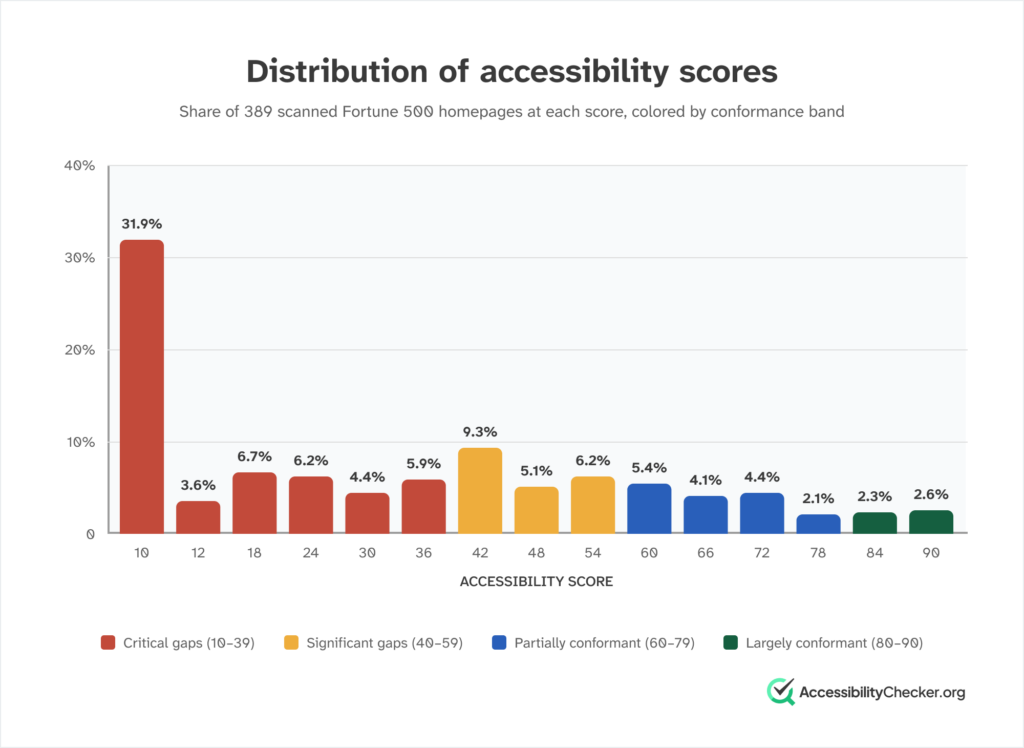
The scanner only returns certain scores between 10 and 90, so results bunch up on a handful of numbers instead of spreading evenly. The spread below is the clearest view of the sample.
Grouped into Bands
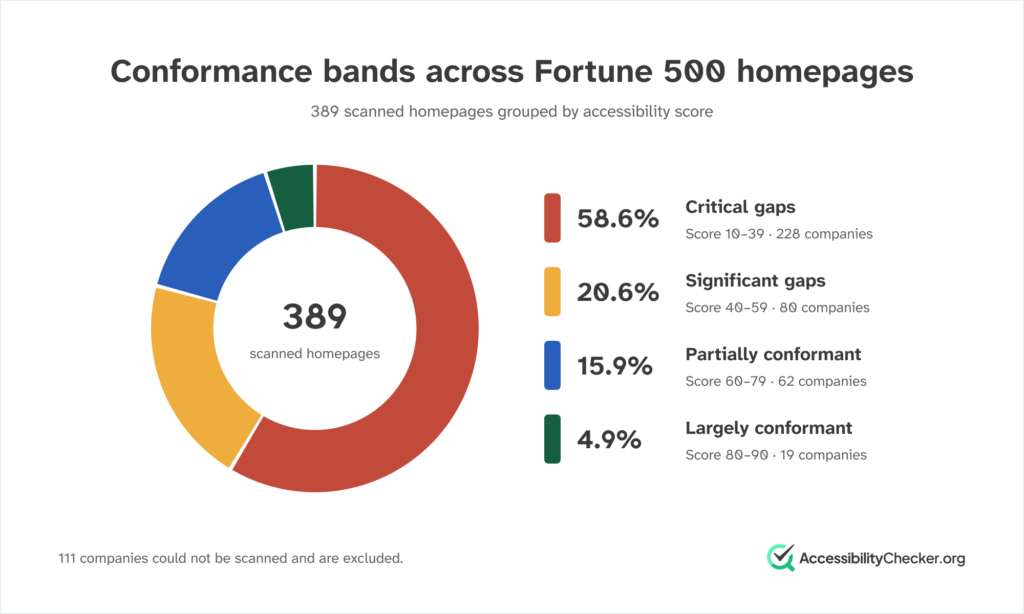
Bands are this study’s own grouping of the score, not an official WCAG classification. Almost a third of the sample sits on the floor of the scale at 10, which means the scanner stopped telling them apart. Those 124 homepages should be treated as badly failing, not ranked against each other.
Failing Elements
Failing elements are counted separately from failed checks, because one broken rule can affect many elements on a page.
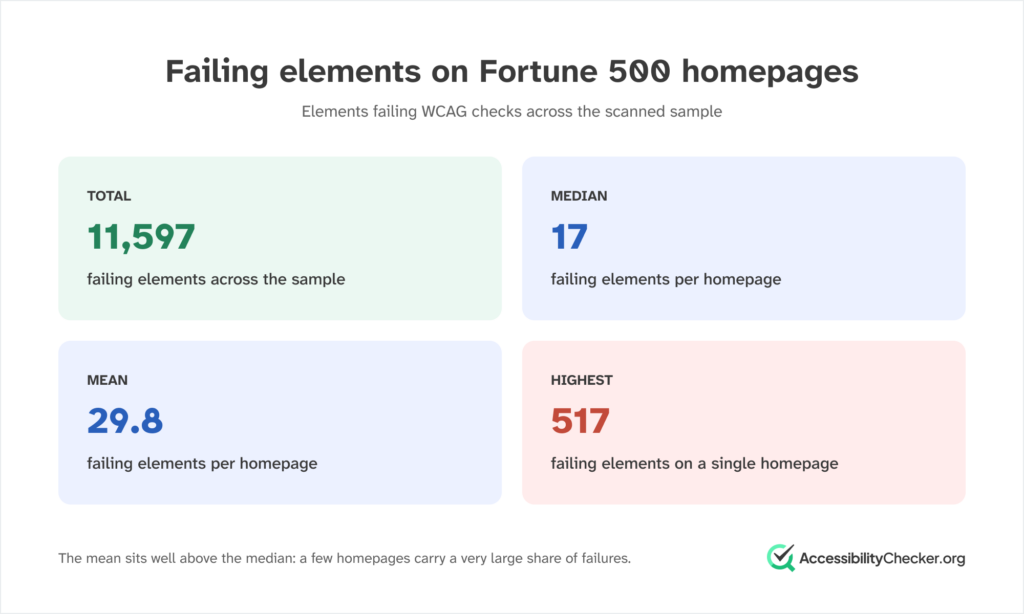
The worst eight homepages in the sample carried between 148 and 517 failing elements each. The highest of them runs an accessibility overlay.
Final Thoughts
The most useful finding here is the one that looks like nothing happened.
69.2% of the companies we scanned publish an accessibility statement. They fail at 90.0%. The companies with no statement fail at 91.7%.
That is not bad faith. Most of these statements read like someone meant them. The gap is between what a company intends and what reaches the live site: a shared component with a duplicate ID, a nav whose links have no text, a brand color that never passes contrast. Template problems, which is why they repeat.
They are also fixable, usually once in a component rather than page by page. Start with duplicate IDs, link text, button names and contrast. Then publish a statement that can be checked: the standard, the level, when it was last tested, how, and what still fails. And test the page, rather than trusting that it is fine.