SEO vs GEO vs AEO vs Agent Readiness: What Is the Difference?



On May 15, 2026, Google tried to end an argument the SEO industry had been having for two years.
Its new guide to optimizing for generative AI search defined AEO and GEO, then said that from Google Search’s point of view, optimizing for AI search is optimizing for search, “and thus still SEO.”
A few days earlier, a different Google team shipped something that seemed to say the opposite. Lighthouse 13.3, the site-auditing tool built into Chrome, added a brand-new Agentic Browsing category. It sits next to the SEO audits, not inside them.
Both teams are right. They’re answering different questions.
SEO, AEO and GEO are about whether people, and the AI answering them, can find and trust your content. Agent readiness asks something else: whether an AI agent can actually use your site.
This guide explains all four in plain English, shows where they overlap, and helps you decide which one deserves your time first.
SEO vs GEO vs AEO vs Agent Readiness at a Glance
Short on time? Here’s the whole comparison in one table.
| SEO | AEO | GEO | Agent readiness | |
|---|---|---|---|---|
| The question it answers | Can people find my page? | Is my page the answer? | Does AI cite or mention me? | Can an AI agent use my site? |
| Where you show up | Ranked links in search results | Featured snippets, voice answers, AI Overviews | ChatGPT, Perplexity, Gemini and AI Mode answers | Inside an agent’s task: a form, a cart, a booking |
| Who you’re working for | Search engines and the people using them | People who want one quick answer | AI models that write answers | AI agents acting for a person |
| What you mostly work on | Crawlability, content, links, page speed | Clear questions and direct answers | Original facts, a consistent brand, trusted mentions | Accessibility tree, semantic HTML, stable layouts, agent protocols |
| How you measure it | Rankings, clicks, organic traffic | Answer and snippet ownership | Citations and share of voice in AI answers | Whether agents complete tasks; audits like Lighthouse Agentic Browsing |
The first three overlap heavily. Google treats them as one discipline, and most of the work is the same.
The fourth is different in kind. SEO, AEO and GEO decide whether you get seen. Agent readiness decides whether anything can get done once an agent arrives.
What Is SEO?
SEO (search engine optimization) is the work of getting your pages found and ranked in search engines like Google and Bing.
It’s the oldest of the four, and it rests on three things:
- Technical health. Search engines can crawl your pages, index them and load them quickly.
- Content. Your pages answer what people are actually searching for, better than the alternatives.
- Authority. Other trusted sites link to you and talk about you.
The goal has always been the same: show up high in the results, so people click through to your site.
What’s changed?
The click is getting harder to win. When Google shows an AI summary, Pew Research found people clicked a regular search result on 8% of visits, compared with 15% when there was no summary.
That’s the reason AEO and GEO exist. People still search. More of them just get their answer without visiting anyone.
What hasn’t changed
SEO is still the foundation for everything else. Google says its AI features use retrieval-augmented generation to pull pages from the same Search index, and a page has to be indexed and eligible for a snippet before it can appear in AI Overviews or AI Mode.
In other words, if Google can’t find you, its AI can’t quote you either.
SEO in one line: get found, get ranked, get the click.
What Is AEO (Answer Engine Optimization)?
AEO (answer engine optimization) is the work of making your content the answer, not just one of ten blue links.
It grew up with featured snippets and voice assistants. When someone asks Google, Siri or Alexa a simple question, there’s room for one answer. AEO is about being that answer.
Today the biggest “answer engine” is Google’s AI Overview, the summary that now sits above many search results. Chatbots like ChatGPT and Perplexity are answer engines too.
In practice, AEO means writing so a machine can lift a clean answer straight out of your page:
- Lead with the answer. Put a direct, one- or two-sentence answer right under the question.
- Use real questions as headings. Match the way people phrase them, like “Is AEO the same as GEO?”
- Keep it scannable. Short paragraphs, lists for steps, tables for comparisons.
- Add an FAQ for the follow-up questions people ask next.
If that sounds like good writing for humans, it is. Google’s own guide says you don’t need to rewrite content just for AI, and that structured data isn’t required to appear in AI features, although it still helps with rich results.

AEO in one line: be the answer people (and AI) read first.
What Is GEO (Generative Engine Optimization)?
GEO (generative engine optimization) is the work of getting your brand and content cited or mentioned in AI-written answers.
The term comes from a 2023 research paper by a team from Princeton, Georgia Tech, the Allen Institute for AI and IIT Delhi. They found that adding citations, quotations and statistics to a page could lift its visibility in AI answers by up to 40%.
Where AEO is about one answer box, GEO is about the whole conversation. When someone asks ChatGPT “what’s the best accounting software for a small agency?”, the AI pulls from many sources and writes its own answer. GEO asks whether your name ends up in it.
That changes what matters:
- Original information. AI models have read the generic advice already. A first-hand test, your own data or a real case study gives them something new to cite.
- A consistent brand story. AI answers draw on what’s said about you across the web, from reviews to forums to news articles. If those sources disagree, the AI may too.
- Facts that are easy to quote. Clear numbers, dates and named sources travel well into AI answers.
One warning. Google’s guide says chasing inauthentic “mentions” isn’t as helpful as it might seem, because its AI features rely on the same spam systems as the rest of Search. Buying your way into Reddit threads isn’t a strategy.
GEO vs AEO: is there a real difference?
Honestly, it’s thin. Both are about visibility in AI answers, and most of the work is the same.
The useful distinction is the outcome you’re tracking. AEO counts whether you are the answer. GEO counts whether you’re in the answer, often as one of several sources or brands named.
And Google lumps them together. Its guide defines both terms in a single paragraph and files them under SEO.
GEO in one line: be the source AI trusts enough to name.
What Is Agent Readiness?
Agent readiness is how well an AI agent can use your website to get something done: find a product, fill in a form, book a slot, complete a checkout.
That’s the big difference from the other three. SEO, AEO and GEO are about AI reading your content and talking about it. Agent readiness is about AI acting on your site, on behalf of a real person.
This isn’t hypothetical anymore. ChatGPT, Claude, Gemini and Perplexity all ship agents that can click through websites. (We compared them in our guide to the best AI agents.)
How agents see your site
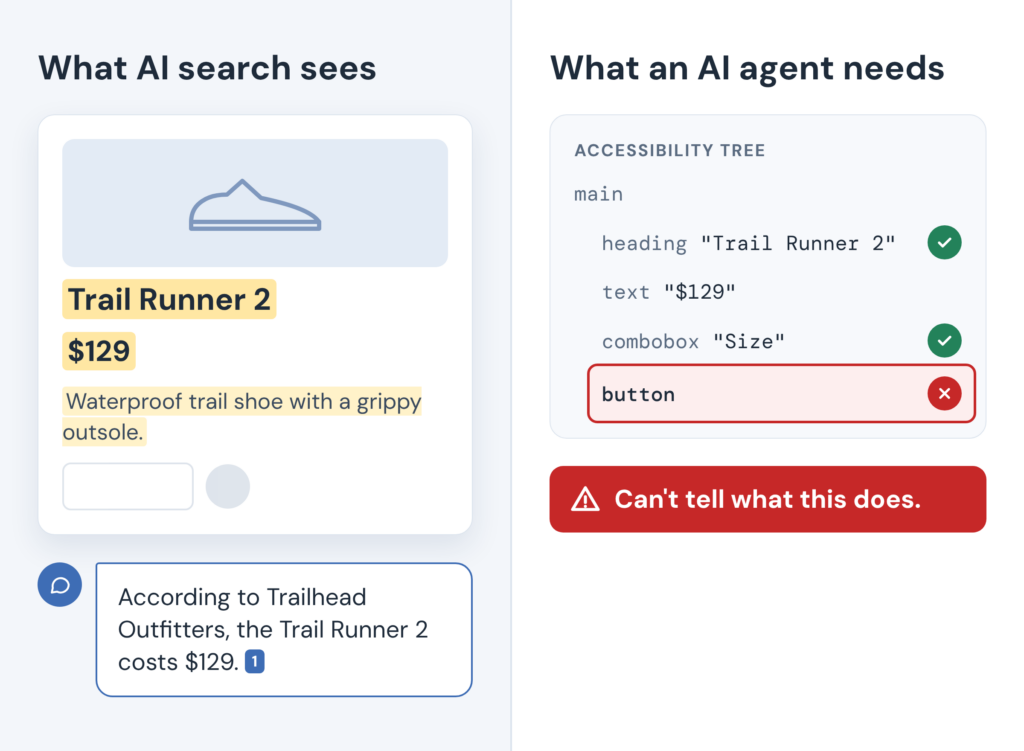
An agent doesn’t look at your page the way you do. Google’s search guide says browser agents work by analyzing screenshots, inspecting the DOM and interpreting the accessibility tree.
That last one matters most. The accessibility tree is the stripped-down version of your page that screen readers use: every button, link and form field, with its role, its name and its state.
Chrome’s Lighthouse team puts it bluntly. Its documentation says agents rely on the accessibility tree as their primary data model, and calls semantic HTML and proper labels the “machine-eye view” of a page.
So a page can rank first on Google and be quoted by ChatGPT, and an agent still can’t buy from it. If the “Add to cart” button is an unlabelled div, the agent sees a box it can’t name.
How agent readiness is measured
There’s no single standard yet, but two big names now publish checks.
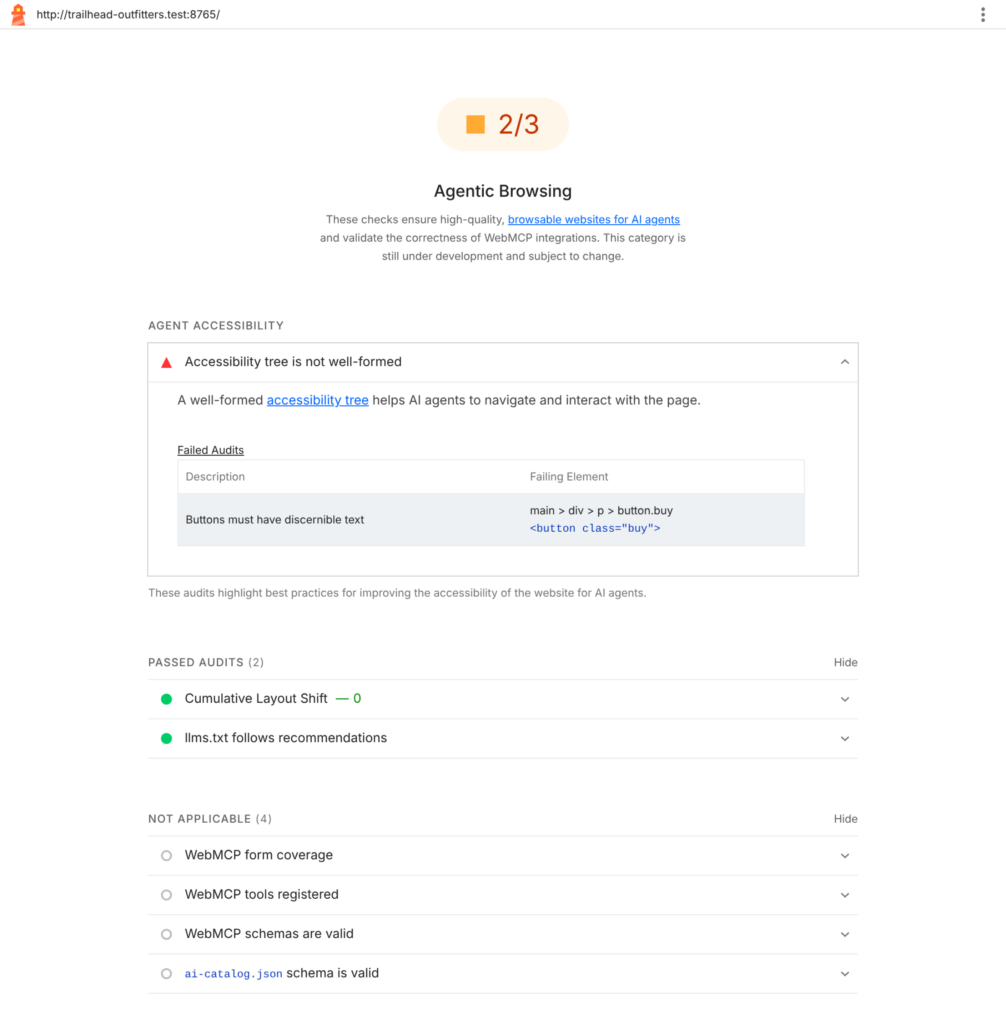
Chrome Lighthouse (Agentic Browsing). Lighthouse 13.3 added an experimental category that checks four things: WebMCP integration, an llms.txt file, accessibility for agents, and layout stability.
The accessibility audits focus on whether every interactive element has a programmatic name, whether roles are valid, and whether anything interactive is hidden from the tree. It shows a pass ratio rather than a 0 to 100 score, because the standards are still settling.
Cloudflare’s Agent Readiness score. Launched in April 2026, isitagentready.com leans toward protocols. It checks discoverability (robots.txt, sitemaps), content (Markdown versions of pages), bot access control, and capabilities like MCP and WebMCP. In May, Cloudflare added the same report to its URL Scanner.
Cloudflare’s first scan of the web’s busiest sites shows how early this is. Only 4% had declared AI usage preferences, 3.9% served Markdown to agents, and fewer than 15 sites used MCP Server Cards or API catalogs.
The foundation under the protocols
New protocols like WebMCP and llms.txt get the headlines. But notice what both scanners test underneath them: whether a machine can understand your page’s structure.
That’s the same requirement WCAG has had for years. Success criterion 4.1.2, Name, Role, Value, asks that every control tells assistive technology what it is and what it’s called. Agents read exactly that information.
To be clear, that’s not why you should make your site accessible. The people who use screen readers and keyboards are reason enough. But if you’ve already done that work, you’ve done much of the agent-readiness work too.
Agent readiness in one line: make sure an AI agent can actually finish the job once it arrives.
Ranked, Answered, Cited, Used: How the Four Fit Together
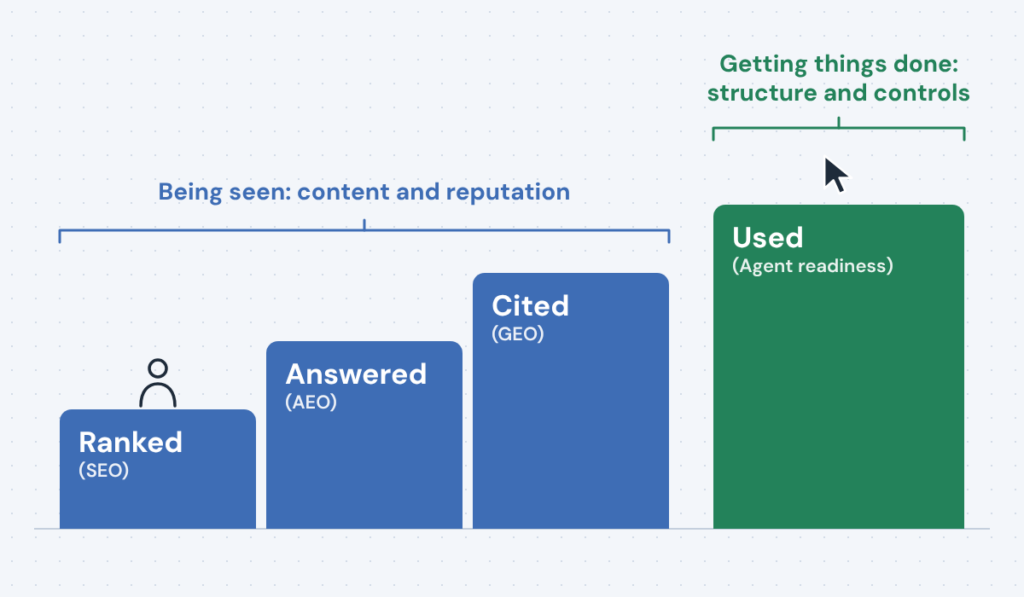
The easiest way to keep these straight is to ask what each one wins you.
- SEO gets you ranked. You appear in the results.
- AEO gets you answered. Your content becomes the answer people read.
- GEO gets you cited. AI names you when it writes its own answer.
- Agent readiness gets you used. An AI agent can complete a task on your site.
The first three are a ladder. Each one builds on the one below it, and Google’s own guide treats them as a single discipline.
The fourth step is a different kind of work. The first three are judged on your content and your reputation. Agent readiness is judged on whether your controls actually work.
What all four share
Some work pays off across every one of them:
- Crawlable, fast pages. If bots can’t load your page, nothing else matters.
- Clear structure. Real headings, real lists, real buttons. Google’s guide recommends semantic HTML partly because it helps screen readers parse and navigate a page.
- Content that loads without waiting on scripts. Prices, stock and key facts that only appear after JavaScript runs are a risk for crawlers and agents alike.
Where they split
Picture an online store with a great product page. It ranks on page one, it’s the AI Overview answer for “best waterproof trail shoes,” and ChatGPT recommends it by name.
That’s SEO, AEO and GEO all working.
Now a shopper’s agent arrives to buy a pair. The size picker is built from plain divs with no label.
The “Add to cart” icon has no accessible name. The agent can’t tell which control does what, so it gives up or picks a competitor.
All that visibility, and no sale. That’s the gap agent readiness covers.
PRO TIP: The fastest way to spot the gap is to look at your key page the way an agent does. Open Chrome DevTools, go to the Elements panel, and turn on the full-page accessibility tree. Then find your main button, like “Add to cart” or “Book now,” and check it has a clear name. Our guide to the accessibility tree walks through it step by step.
Where to Start
You don’t need four separate strategies. Work up the ladder, and stop where your business stops needing it.
1. Fix your SEO basics first.
Everything else depends on it. Make sure your important pages are indexed, load quickly and work on mobile. Google says pages must be indexed and eligible for a snippet before they can show up in its AI features at all.
2. Write answer-first content (AEO).
Go through your top pages. Does each one answer its main question in the first couple of sentences? Add an FAQ where people clearly have follow-up questions.
3. Give AI something worth citing (GEO).
Publish things only you can: your own data, real customer results, first-hand tests. Keep your key facts, like prices, features and policies, consistent everywhere they appear online.
4. If people act on your site, check agent readiness.
This step matters most if visitors buy, book, sign up or fill in forms. Start with the basics before any new protocols:
- Every button, link and form field has a clear accessible name.
- Form controls are real HTML elements, not styled divs.
- Key information, like price and availability, is in the page without waiting on scripts.
- Error messages are announced, not just shown in red.
- Layouts don’t jump around as the page loads.
Once that’s solid, look at the newer layer: WebMCP, llms.txt and, for stores, agentic commerce protocols.
PRO TIP: If you only blog or publish, you can mostly stop at step 3 for now. Agents will still read your pages, but the work of making them usable is mainly about forms and checkouts. Revisit agent readiness when you add anything people can do on your site, not just read.
What you can skip
Google’s guide is refreshingly direct about the tactics that don’t help with its AI features. For Google Search, you can ignore:
- Creating an llms.txt file to appear in AI Overviews or AI Mode.
- “Chunking” content into tiny pieces for AI.
- Rewriting pages just for AI systems.
- Chasing inauthentic mentions.
- Adding special “AI schema.”
One caveat on llms.txt. Google Search ignores it, but Chrome’s Lighthouse checks for it as part of agentic browsing readiness. It won’t help your rankings. It may help browser agents get a quick summary of your site. Treat it as optional, low-cost and low-priority.
SEO vs GEO vs AEO FAQs
What's the difference between SEO, GEO and AEO?
SEO gets your pages ranked in search results. AEO makes your content the direct answer people see first. GEO gets your brand cited or mentioned in AI-written answers from tools like ChatGPT and Perplexity. All three are about visibility, and Google treats them as one discipline.
Is AEO the same as GEO?
Almost. Both aim for visibility in AI answers, and most of the work overlaps. AEO focuses on being the single answer, while GEO focuses on being one of the sources an AI names.
Is AI SEO called AEO?
Sometimes. "AI SEO," AEO, GEO and AIO (AI optimization) are all used loosely for the same idea: being visible in AI-powered search. None of them is an official standard.
Is SEO dead now with AI?
No. Google's AI Overviews and AI Mode pull from its regular search index, so a page that isn't indexed can't be quoted. What has changed is that fewer searches end in a click, so being the answer matters more than it used to.
Can I use GEO instead of SEO for my website?
Not really. GEO builds on SEO rather than replacing it. If search engines can't find and trust your pages, AI tools that rely on them are unlikely to cite you either.
What is agent readiness?
Agent readiness is how well AI agents can use your website to complete tasks, like buying a product or booking an appointment. It depends mostly on clear page structure: named buttons, labelled form fields and a clean accessibility tree.
How is agent readiness different from SEO?
SEO, AEO and GEO help AI find and talk about your content. Agent readiness helps AI act on your site. A page can rank first and still be impossible for an agent to use.
Do I need an llms.txt file?
Not for Google Search, which ignores it. Some AI tools and Chrome's Lighthouse agentic audit do look for it, so it can be a small, optional extra once your basics are solid.