- Categories (3)
- Guides - Platform
- Guides - Reviews
- Legislations
Agentic Commerce: The Complete Guide


In March 2026, the most famous agentic checkout in the world quietly shut down.
ChatGPT’s Instant Checkout had launched six months earlier to great excitement. Ask ChatGPT for a gift, and it would buy the thing for you without you ever leaving the chat.
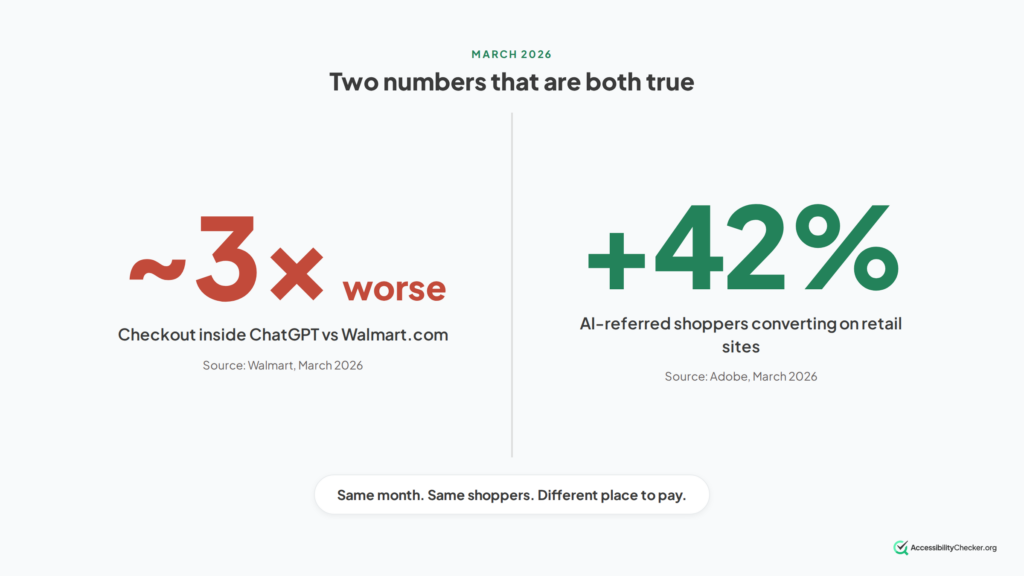
Then the numbers came in. Walmart said purchases completed inside ChatGPT converted at roughly a third of the rate of shoppers it sent to its own website.
That same month, Adobe reported that shoppers arriving at retail sites from AI tools were converting 42% better than everyone else.
Both of those numbers are true. Understanding why is the whole point of this guide.
TL;DR Agentic commerce is a form of shopping where an AI agent does some or all of the work on a person’s behalf: finding products, comparing them, filling a cart, and sometimes paying.
- What Is Agentic Commerce?
- Why Agentic Commerce Matters Now
- How AI Agents Buy: The Four Gates
- What Happened to ChatGPT Instant Checkout?
- The Agentic Commerce Protocol (ACP), Explained
- ACP vs UCP vs AP2: The Agentic Commerce Protocols Compared
- WebMCP: Agentic Commerce on Your Own Pages
- llms.txt and Agentic Commerce
- Agent Readiness Standards Compared
- How to Get Your Store Ready for Agentic Commerce
- An Agent-Ready Store Is Mostly an Accessible Store
- What Nobody Knows Yet
- Where to Start
- Agentic Commerce FAQs
What Is Agentic Commerce?
Agentic commerce is commerce carried out by AI agents acting on behalf of a person or a business.
Traditional ecommerce assumes a human is at every step. A person searches, clicks, compares, adds to cart, types in a card number and presses “Buy”.
In agentic commerce, some of those steps are handed to software that can reason, use tools, and take actions. The person states an intent (“I need running shoes for wide feet, under $150, delivered by Friday”) and the agent does the legwork.
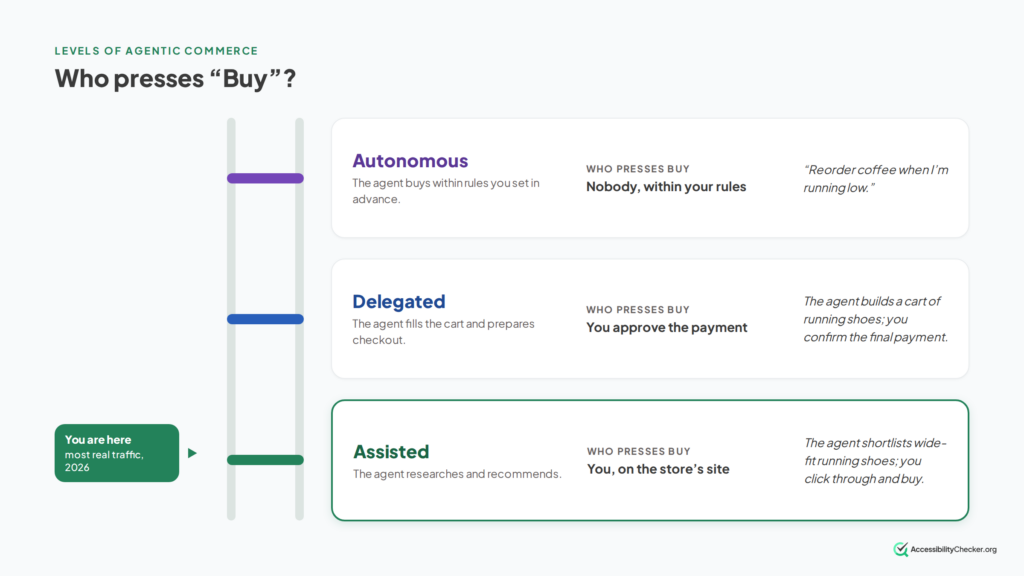
It helps to think about agentic commerce as a spectrum rather than one thing, though.
Assisted. The agent researches and recommends. The human clicks through and buys on the store’s site. This is where almost all agentic commerce actually happens today.
Delegated. The agent fills the cart and prepares the checkout. The human approves the final payment. Most of the new protocols are built for this level.
Autonomous. The agent buys within rules the human sets in advance, with no one watching. Think “reorder coffee when I’m running low” or “buy the concert tickets the second they go on sale”. This is the frontier, and it’s where the payment networks are putting most of their effort.
Why Agentic Commerce Matters Now
The forecasts are big, and they disagree with each other by an order of magnitude.
McKinsey estimates agentic commerce could orchestrate up to $1 trillion in US retail revenue by 2030, and $3 to $5 trillion globally.
Morgan Stanley takes a stricter definition that requires the agent to actually act, and lands at $190 to $385 billion of US ecommerce, or 10 to 20% of the total.
We’d treat the exact numbers with suspicion. Most of the gap comes down to what each firm counts as “agentic”.
What’s harder to argue with is the traffic that already exists.
Adobe, which tracks more than a trillion visits to US retail sites, reported AI-referred traffic up 393% year on year in Q1 2026. A year earlier, that traffic converted worse than normal visitors. By March 2026 it converted 42% better.
That shift matters more than any 2030 projection. AI-referred visitors used to be tire-kickers. Now they arrive having already done their research.
How AI Agents Buy: The Four Gates
Every conversation about agentic commerce eventually becomes a conversation about protocols. ACP, UCP, AP2, MCP, WebMCP. It gets overwhelming fast.
We’ve found it much easier to start from the agent’s point of view. To buy something from your store, an agent has to get through four gates, in order.
THE FOUR GATES (n.)
The four things an AI agent must be able to do to buy from a store: Find it, Read it, Act on it, and Pay it. Fail any gate and the sale doesn’t happen, no matter how good the later gates are.
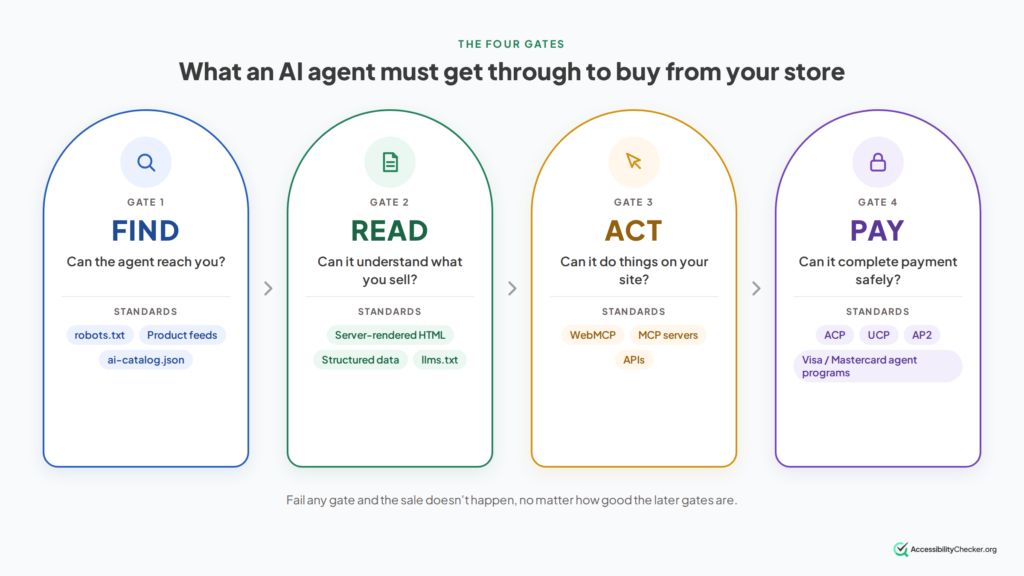
- Find. Can the agent reach you? This is crawler access, product feeds submitted to AI platforms, and not having your firewall throw a 403 at every AI user agent.
- Read. Once it arrives, can it understand what you sell? Prices, stock, variants, sizes, shipping and returns, in the HTML the agent actually receives.
- Act. Can it do anything? Search your catalog, pick a variant, add to cart. Either by clicking your interface like a person would, or by calling tools you’ve given it.
- Pay. Can the payment happen safely, with the right person approving it, without the agent ever seeing a card number?
Here’s what most coverage misses. Almost all of the protocol noise is about gate four. Almost all of the lost sales happen at gates one and two.
A study of 1,033 real agent runs, published as part of the AgentReady standard, tested sites under different conditions. Only two changes actually broke an agent: hiding the answer behind JavaScript, and blocking access. Everything else was an optimization.
REMEMBER: A payment protocol can’t sell a product an agent never found. Work the gates in order.
What Happened to ChatGPT Instant Checkout?
Instant Checkout is the best case study in agentic commerce so far, precisely because it didn’t work.
OpenAI launched it on September, 29th 2025, alongside the Agentic Commerce Protocol it built with Stripe. At launch it only supported single-item purchases from US Etsy sellers, with Shopify merchants promised to follow.
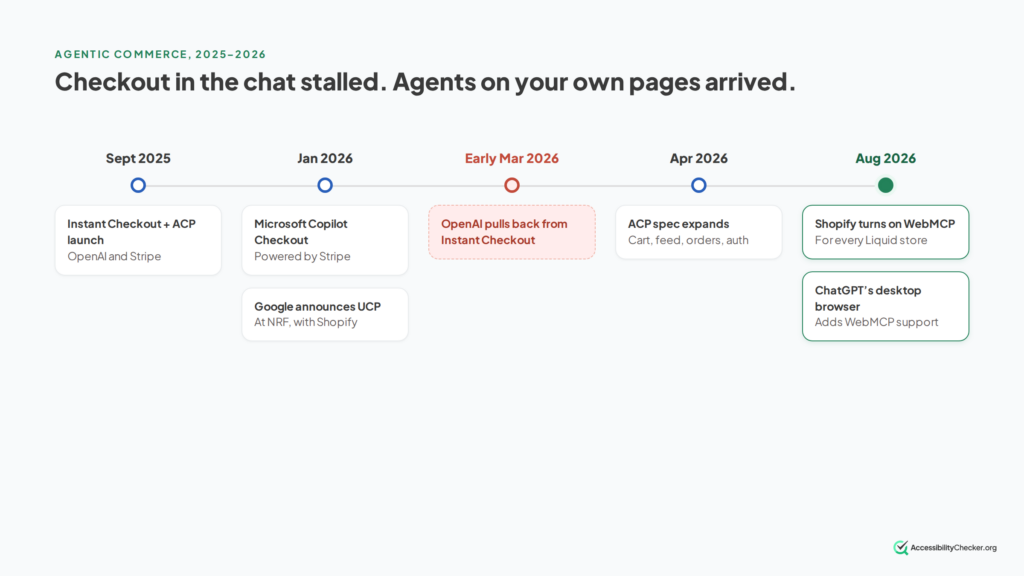
In early March 2026, The Information reported that OpenAI was pulling back. On the same day, Shopify’s president Harley Finkelstein told an investor conference that only about a dozen of Shopify’s millions of merchants had actually gone live.
Then Walmart shared the conversion number. Checkout inside ChatGPT converted at roughly a third of the rate of shoppers who were sent to Walmart’s own site to finish.
Reporting at the time pointed to a few causes. Only single items, no multi-item carts. Product data that was often wrong, including stock and shipping costs. Merchants reluctant to hand over the moment where loyalty programs, saved addresses and upsells live.
OpenAI’s replacement direction is telling. ChatGPT now leans into discovery, while retailers like Walmart build their own experiences inside ChatGPT, where shoppers can link their existing account, loyalty benefits and saved payment methods.
So what’s the lesson?
Agents turned out to be very good at the deciding and not yet very good at the buying. The shopper’s trust, their saved details and their habits still live on your store.
That’s why the 42% number and the “three times worse” number can both be true. The agent does the research. Your site closes the sale.
PRO TIP: If you’re deciding where to invest this year, invest where the sale actually happens today: your own product pages and checkout, made legible to agents. In-chat checkout may come back. Your site isn’t going anywhere.
The Agentic Commerce Protocol (ACP), Explained
The Agentic Commerce Protocol is an open standard for agent-initiated checkout, co-developed by OpenAI and Stripe and released under the Apache 2.0 license on September, 29th 2025.
Instant Checkout was the first thing built on it. Instant Checkout is gone. ACP isn’t.
What ACP actually does
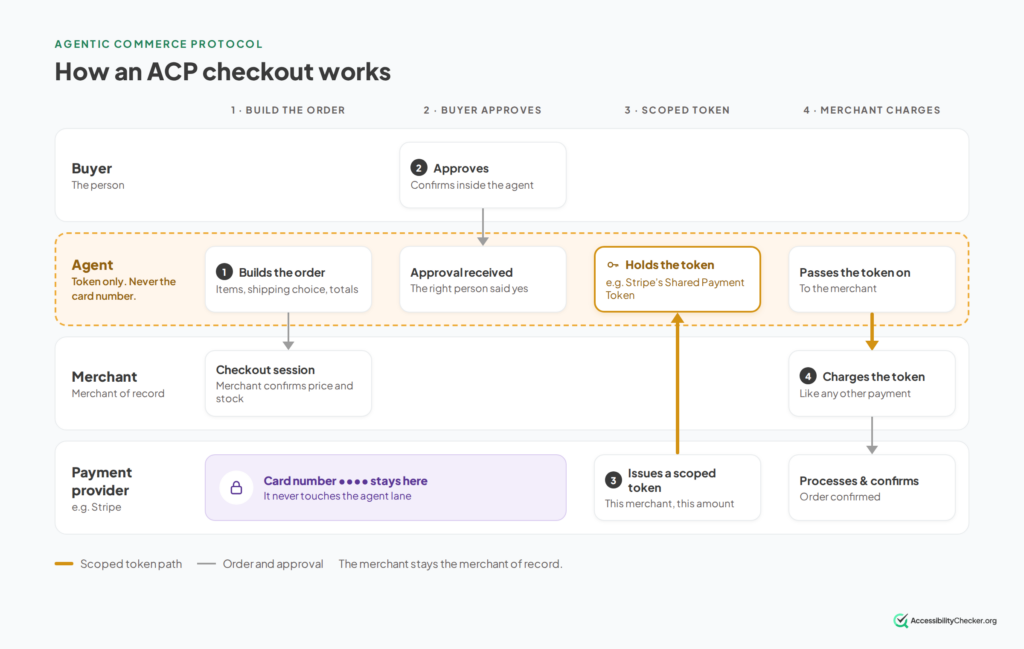
ACP defines how an agent, a merchant and a payment provider talk to each other during checkout, while the merchant stays the merchant of record. You keep your catalog, pricing, fulfillment, returns and the customer relationship.
The clever part is the payment handoff. The agent never holds the buyer’s card number.
- The agent builds the order. It gathers items, shipping choice and totals from the merchant through a checkout session.
- The buyer approves. The person confirms the purchase inside the agent’s interface.
- A scoped token is issued. The payment provider creates a token limited to this merchant and this amount. Stripe’s version is called a Shared Payment Token.
- The merchant charges it. The merchant processes the token through its own payment provider, exactly as it would any other payment, and confirms the order.
What changed in 2026
ACP started as a narrow, checkout-only spec. The 2026-04-17 release added cart, product feed, orders, authentication and Model Context Protocol compatibility, turning it into something that covers most of the purchase lifecycle.
It still deliberately leaves some things out of scope, including returns and exchanges, tax configuration and fraud modeling. Those stay with your payment provider and commerce stack.
And importantly, ACP doesn’t make your products appear anywhere by itself. Each AI platform runs its own merchant onboarding and product discovery.
Who uses ACP now?
Stripe is the main route in. Its Agentic Commerce Suite launched in December 2025, and Stripe also powers Microsoft’s Copilot Checkout, announced in January 2026. In the same post, Stripe says more than 25 companies, including Salesforce, Squarespace and PwC, have endorsed the protocol.
If you’re on Stripe, most of the ACP work is done for you. If you’re not, check whether your payment provider supports it before building anything.
ACP vs UCP vs AP2: The Agentic Commerce Protocols Compared
ACP isn’t the only protocol. By mid-2026 there were three big names, and they sit at slightly different layers.
UCP (Universal Commerce Protocol)
Google and Shopify announced the Universal Commerce Protocol at the NRF conference on January, 11th 2026. It covers the whole shopping journey, from discovery through checkout to post-purchase, across Google surfaces like AI Mode in Search and the Gemini app.
A March 2026 update added carts, live catalog access and identity linking, so loyalty benefits can follow the shopper. In May, Google expanded Universal Cart, which lets shoppers save products from multiple retailers and check out with Google Pay or on the retailer’s own site.
For most merchants, UCP won’t be an engineering project. Google is building onboarding into Merchant Center, and products marked with the native_commerce attribute can show a checkout button in AI Mode and Gemini.
Checkout is currently limited to eligible merchants.
AP2 (Agent Payments Protocol)
AP2 is narrower. It’s about proving that a person actually authorized an agent to pay, and within what limits.
Google announced it in September 2025 and donated it to the FIDO Alliance in April 2026, the same body behind passkeys.
Version 0.2 added “Human Not Present” payments, where an agent can buy autonomously under instructions the person approved in advance. Mastercard contributed a companion framework, Verifiable Intent, which keeps a tamper-proof record of what the user authorized.
And the card networks
Visa’s Trusted Agent Protocol and Mastercard’s Agent Pay tackle a different problem: telling a legitimate shopping agent apart from a scraper or a fraud bot. Both use Web Bot Auth, a Cloudflare-proposed approach where agents cryptographically sign their requests.
This matters to you more than it sounds. Your bot protection is currently deciding, on your behalf, which agents are allowed to shop.
| Protocol | Behind it | What it covers | Gate | Status (Sept 2026) |
| ACP | OpenAI and Stripe | Checkout, plus cart, feed and orders since April 2026 | Act, Pay | Beta spec; used by Stripe merchants and Copilot Checkout |
| UCP | Google and Shopify, with a wider coalition | Full journey across Google surfaces | Find, Act, Pay | Live for eligible merchants; onboarding via Merchant Center |
| AP2 | Google, now the FIDO Alliance | Proof the user authorized the payment | Pay | v0.2; in FIDO standards process |
| Visa TAP / Mastercard Agent Pay | Visa, Mastercard, with Cloudflare | Verifying that an agent is legitimate | Find, Pay | Live programs; merchant-side verification |
Do you have to pick one? No. Payment providers are already building to sit across all of them.
Adyen launched a suite in June 2026 designed so merchants integrate once and sell across AI platforms, whatever protocol each one uses.
Our advice: let your commerce platform and payment provider carry the protocol layer. Spend your own effort on the gates they can’t fix for you.
REMEMBER: Every protocol on this list keeps you as the merchant of record. None of them changes the fact that the agent is only as good as the product data you give it.
WebMCP: Agentic Commerce on Your Own Pages
Everything so far involves an agent talking to your store from somewhere else: a chat window, an AI search result. WebMCP is different. It works on your own website, in the shopper’s browser.
We’ve written a full guide on what WebMCP is, so here’s the short version.
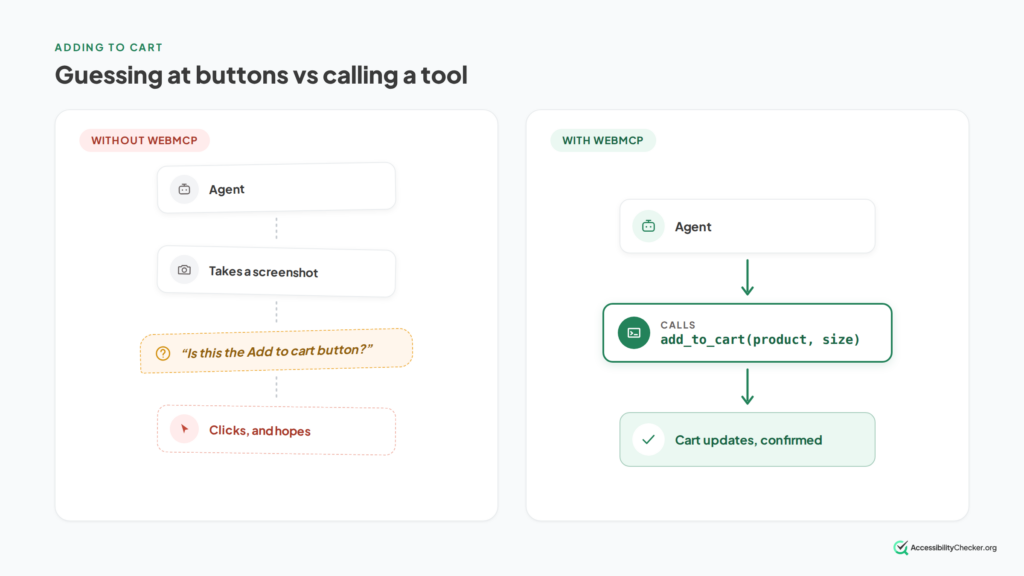
WebMCP lets a web page register “tools” with the browser, things like “search the catalog” or “add this to cart”, with a plain-language description and a defined set of inputs. An AI agent in the browser can call those tools directly instead of guessing which button to click from a screenshot.
Why it suddenly matters for stores
On August, 5th 2026, Shopify turned on WebMCP for every Liquid storefront, plus stores on its Hydrogen developer preview. There’s nothing to install and nothing to configure. According to Shopify’s docs, a compatible agent in a shopper’s browser can now search the catalog, manage the cart and navigate the store on the shopper’s behalf.
A few weeks later, OpenAI added support for these “site tools” to ChatGPT’s built-in desktop browser.
That’s the supply side and the demand side of agentic commerce connecting on ordinary storefronts for the first time.
One thing to know if you test this: Shopify declares its tools in your page’s code, but registers them live in the shopper’s browser. A scanner that reads your HTML can see the declaration but not the live registration.
What WebMCP doesn’t do
Three limits are worth being clear about.
- It doesn’t bring you customers. An agent only learns about your WebMCP tools once it’s already on your page. It lives at the Act gate, not the Find gate.
- It doesn’t take payment. On Shopify, the checkout tool takes the shopper to checkout. The shopper still pays.
- It only covers the standard actions. Shopify’s tools handle Shopify’s standard commerce actions. A product configurator, a fitting-booking widget or a custom bundle builder isn’t exposed unless you register your own tools for it.
It’s also still experimental: a W3C Community Group draft, running as an origin trial in Chrome.
llms.txt and Agentic Commerce
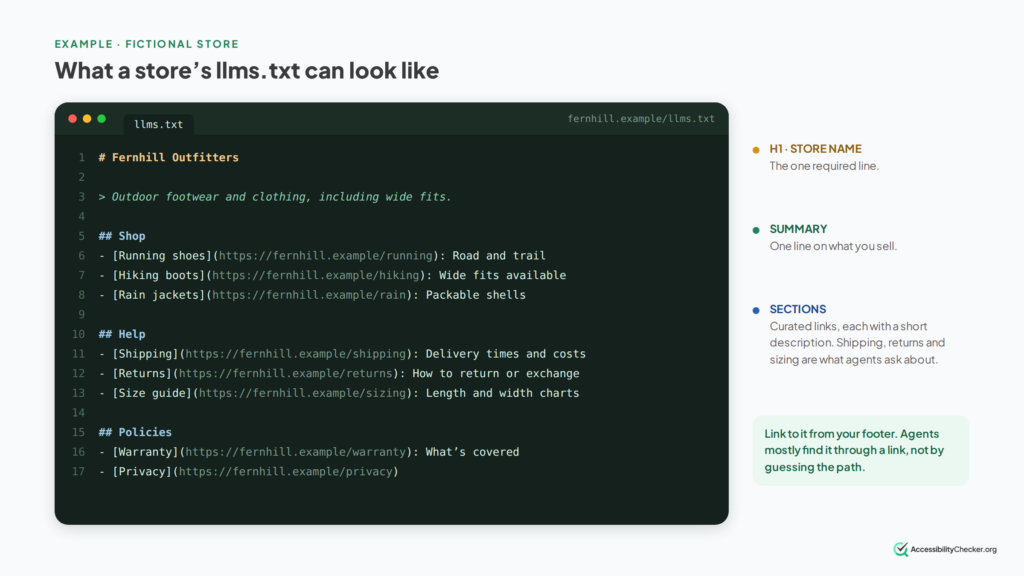
llms.txt is a plain Markdown file at the root of your site that gives AI systems a curated, described index of your most important pages. Jeremy Howard of Answer.AI proposed it in September 2024.
It’s also the most over-sold file in AI optimization right now, so let’s be straight about the evidence.
Google doesn’t use it. Google’s AI optimization guide, updated in June 2026, says Search doesn’t use llms.txt, including for its generative AI features.
Most copies are never requested. Ahrefs looked at 137,210 domains and found 97% of valid llms.txt files got zero requests in May 2026. A separate SE Ranking study of around 300,000 domains found no link between having the file and being cited by AI.
But agents do read it, when you point them at it. This is the nuance most coverage misses. In the AgentReady traces, 86% of llms.txt fetches came through a link on a page the agent had already visited, not from the agent guessing the path. And in about a third of the runs that read it, the agent’s final answer came from its content.
So for a store, llms.txt is a cheap, low-stakes addition. It’s useful for pointing agents at your shipping, returns and sizing pages. Link to it from your footer. Don’t expect it to move rankings or citations on its own.
Agent Readiness Standards Compared
If you’ve run your site through an agent readiness checker lately, you’ve probably been graded against a list of files and standards you’d never heard of.
Some matter a lot for a store. Some barely register yet. Here’s what each one does and who’s behind it.
| Standard | What it is | Who’s behind it | Gate | For a store today |
| AgentReady | A checklist standard, not a file. Defines what a product should implement to be usable by agents from discovery to completion, based on traced agent runs. | Ora, with Vercel, Mintlify and Auth0 (v1.0, August 2026) | All four | Useful reference. Its research backs most of the find-and-read steps in this guide. |
| ARD and ai-catalog.json | A JSON file at /.well-known/ai-catalog.json listing the agent-callable things you offer — MCP servers, agents, APIs — so registries can index them. | Google (announced June 2026), built on the AI Catalog data model from a Linux Foundation working group | Find | Only if you run your own MCP server or public API. Adoption is tiny so far. |
| llms.txt | A Markdown index of your key pages for AI readers. | Jeremy Howard, Answer.AI (community proposal, 2024) | Read | Cheap to add. Link it from your footer. Not a ranking lever. |
| AGENTS.md | A plain Markdown file of instructions for AI agents. Created for coding agents working in a code repository; some sites now also publish one at their root. | OpenAI, now under the Linux Foundation’s Agentic AI Foundation | Read (minor) | Small signal, not a gate. Cheap to add. Don’t expect it to change how shopping agents behave yet. |
| WebMCP | A browser API that lets your pages register tools agents can call. | Google and Microsoft engineers, via a W3C Community Group | Act | Already on if you’re on a Shopify Liquid theme. Otherwise, watch and prepare. |
A few notes on the table.
AGENTS.md is a small signal, not a gate. It started as a way to brief coding tools like Codex, Cursor and Copilot on a codebase, and whether shopping agents read it on a storefront is still unproven. But it takes minutes to write, and some readiness scanners give it a little credit. Add one if you like. Just don’t expect it to fix anything at the first two gates.
ai-catalog.json is genuinely early. One survey found nine publishers serving the file across 37,751 domains. It’s worth knowing about. It isn’t worth losing sleep over.
NOTE: None of these five is a payment standard. If you want the checkout protocols, that’s ACP, UCP and AP2, covered above. Readiness standards are mostly about the first three gates.
How to Get Your Store Ready for Agentic Commerce
Here’s the practical part. We’ve ordered it by gate, because that’s the order agents hit them, and because the early steps cost the least and pay off the most.
Gate 1: Find
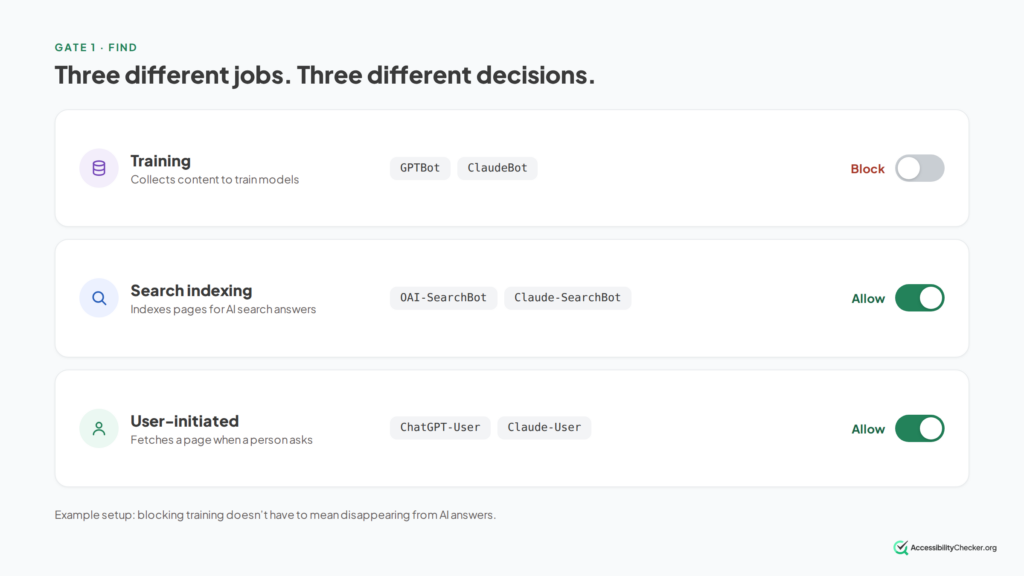
- Stop blocking the agents you want. Check robots.txt, but also check your firewall and bot protection, which is where most blocking actually happens. AI companies run separate crawlers for training, for search indexing and for user-initiated fetches, and you can treat them differently. Blocking training doesn’t have to mean disappearing from AI answers. It’s a legitimate choice. Just be aware that some readiness scanners will show it as a partial restriction rather than a failure.
- Get your product feeds into the places agents shop. Google Merchant Center is now the on-ramp for UCP. OpenAI and others run their own merchant programs. A complete, accurate feed is the single thing most likely to get you recommended, and inaccurate feed data was one of the reasons Instant Checkout struggled.
Gate 2: Read
- Put the important facts in the initial HTML. Price, availability, variants, shipping and returns should be in the page the server sends, not injected by JavaScript after load. Many agents fetch pages without running scripts. If your price only appears after hydration, to them you don’t have a price.
- Add product structured data, and repeat the key facts in visible text. Schema.org Product and Offer markup helps. But some tools convert your page to Markdown and drop script blocks, so the facts need to be in the words on the page too.
- Make your policies easy to find. Shipping times, returns, sizing and warranty are exactly what an agent needs to answer “will this arrive by Friday, and can I send it back?” Give each one a clear page, link it from your footer, and list it in an llms.txt.
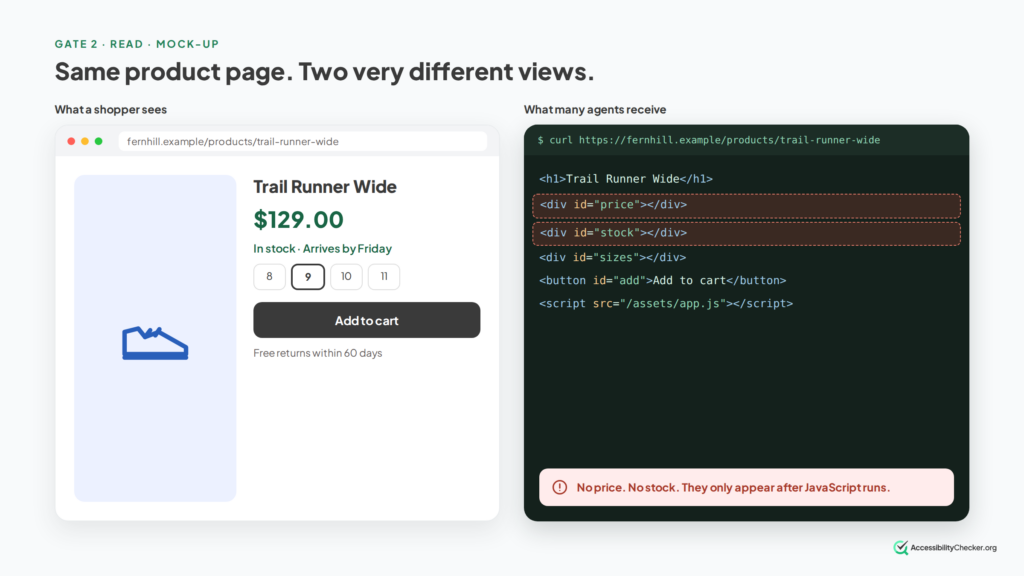
PRO TIP: A quick test: load a product page with JavaScript turned off. Whatever disappears is invisible to a lot of agents.
Gate 3: Act
- Use real forms and real controls. Native select menus, labeled inputs and proper buttons are what both agents and WebMCP’s declarative approach build on. Custom dropdowns made of divs are where agents get stuck. If you’re on Shopify, check that your custom app features work alongside the built-in WebMCP tools. If you’re not, watch WebMCP and start by getting these basics right.
Gate 4: Pay
- Ask your payment provider about agentic payments. Stripe, PayPal, Adyen and others are building agentic protocol support into their platforms. For most stores, this is a conversation and a settings change, not a build.
- Revisit your fraud and bot rules. Rules built to stop bots will increasingly stop paying customers’ agents too. Ask your fraud and CDN providers whether they support Web Bot Auth or the Visa and Mastercard agent programs, so verified shopping agents aren’t treated like scrapers.
An Agent-Ready Store Is Mostly an Accessible Store
Look back at that checklist and something jumps out.
Content that’s in the HTML rather than painted in by scripts. Labeled form fields. Real buttons. Dropdowns built from native controls. Clear, findable policy pages.
That’s not a new list. It’s most of an accessibility audit.
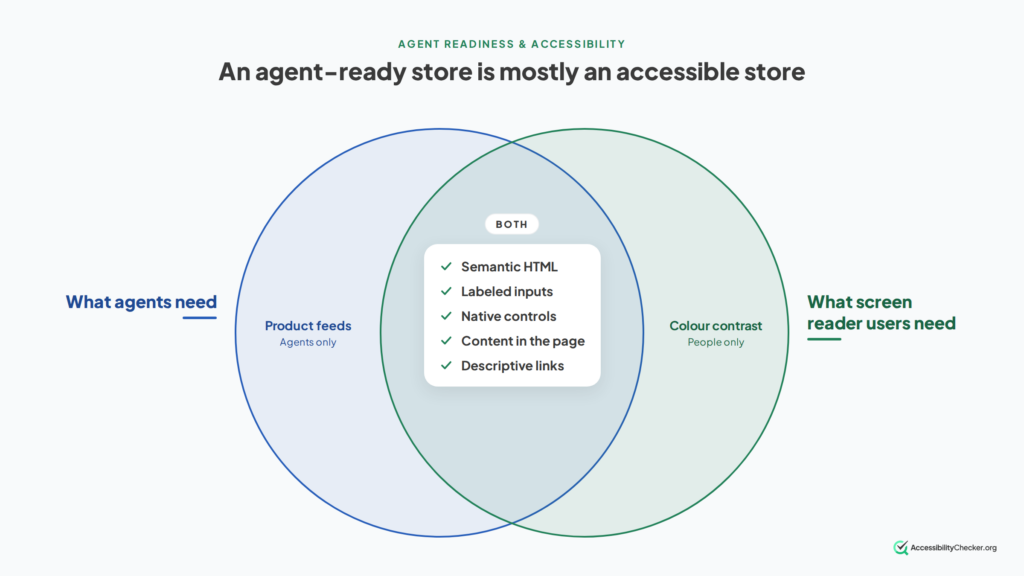
A screen reader user navigating a checkout is doing much the same work an AI agent does: interpreting an interface that was designed to be looked at. The controls that trip up one very often trip up the other.
That’s good news if you’ve already invested in accessibility. You’ve done a large part of the agent-readiness work without calling it that.
And it’s a useful warning if you haven’t. The same shortcuts that shut out disabled shoppers are now shutting out their software too.
REMEMBER: Build for the shopper who can’t see your page, and you’ve mostly built for the agent that can’t either.
What Nobody Knows Yet
We’d rather be honest about the open questions than pretend this is settled.
Which protocol wins? Possibly none, possibly all of them. Payment providers are betting on supporting everything, which is a strong hint about how they see it.
How will you measure it? When an agent researches in one place and the shopper buys in another, attribution gets murky. Most analytics still can’t tell you an agent was involved.
Will in-chat checkout come back? Instant Checkout failed. UCP-powered checkout in Google’s surfaces is live and expanding, and Visa announced in June 2026 that it will secure payments for shopping inside ChatGPT, within user-set limits like spending caps and required approvals. The idea isn’t dead. The first version was.
Who’s liable when an agent buys the wrong thing? AP2 and Verifiable Intent exist precisely because this question isn’t answered yet.
Where to Start
Agentic commerce is still being built, and the protocols will keep changing. What won’t change is the order an agent works in: it has to find your store, read it, act on it, and only then pay. Most stores are losing agent sales at the first two gates, and those are the cheapest to fix. Find. Read. Act. Pay. In that order.
Agentic Commerce FAQs
What is agentic commerce in simple terms?
Shopping where an AI agent does some or all of the work for you: finding, comparing, adding to cart and sometimes paying, based on what you asked for.
What is the Agentic Commerce Protocol?
An open standard from OpenAI and Stripe, released in September 2025, that defines how an agent, a merchant and a payment provider complete a checkout without the agent ever holding the buyer's card details. The merchant stays the merchant of record.
Is ChatGPT Instant Checkout still available?
No. OpenAI pulled back from Instant Checkout in early 2026 and moved toward discovery and retailer experiences inside ChatGPT. The Agentic Commerce Protocol itself continues.
What's the difference between ACP and UCP?
ACP comes from OpenAI and Stripe and centers on checkout. UCP comes from Google and Shopify and covers the full journey across Google's AI surfaces. Both keep the merchant as the merchant of record.
What's the first thing I should do?
Make sure agents can reach your store and read your prices, stock and policies in the page HTML. That's where most agent sales are won or lost today.